
The Achilles tendon is a band of tissue that connects the calf muscles to the heel. The Achilles tendon is the thickest and strongest tendon in the body; a healthy Achilles tendon is capable of taking up to 2 tonnes of load through it.
Contracting the calf muscles pulls the Achilles tendon, which causes the foot to move downwards and the heel to raise – an action that is part of walking, running, jumping, landing and standing on the toes.
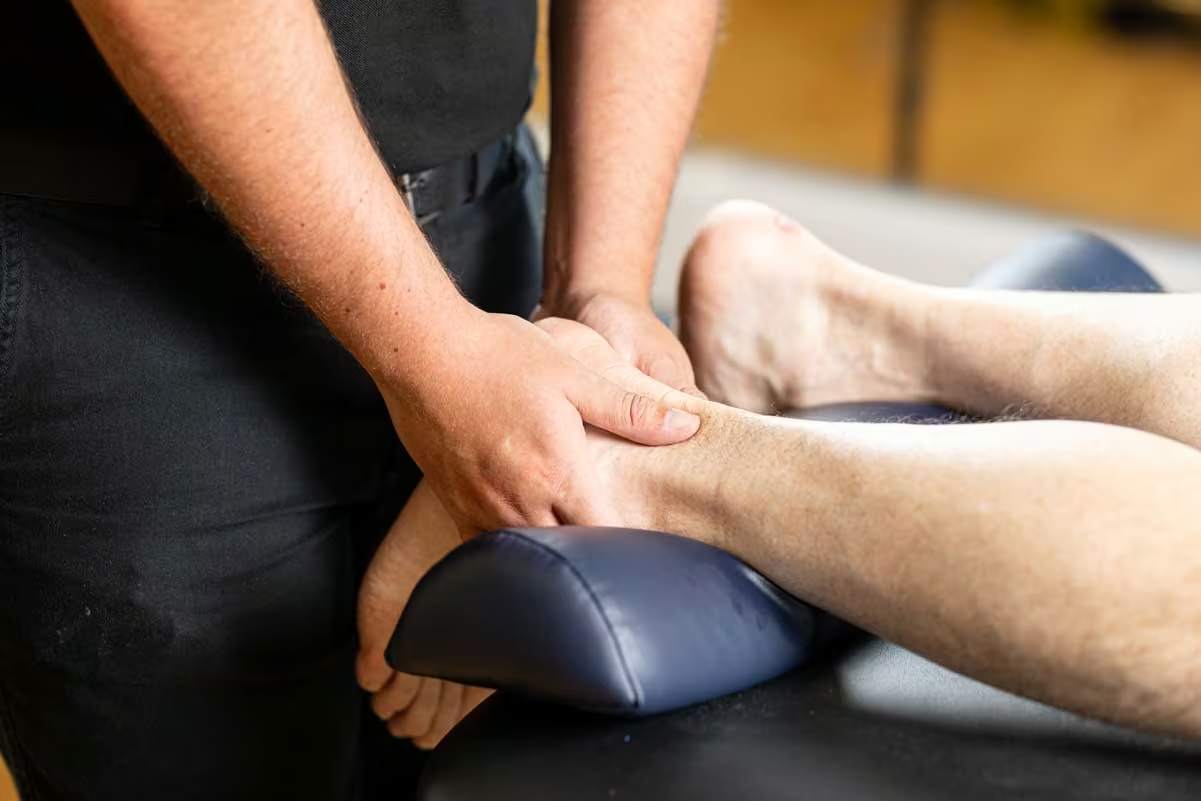
Achilles tendinopathy is the most common cause of Achilles pain. It tends to come on gradually and is associated with a degeneration of the tendon, causing pain and sometimes thickening in the tendon. It is important for your physiotherapist to establish which part of the tendon is causing your problem as this will affect the type of treatment you require.
Treatment usually begins with an eccentric loading program and may progress to involve stretches, strengthening exercises, assessment of footwear and foot position, and advice regarding your sporting activities. Although this can be a stubborn and sometimes frustrating condition, it will normally resolve with physiotherapy.
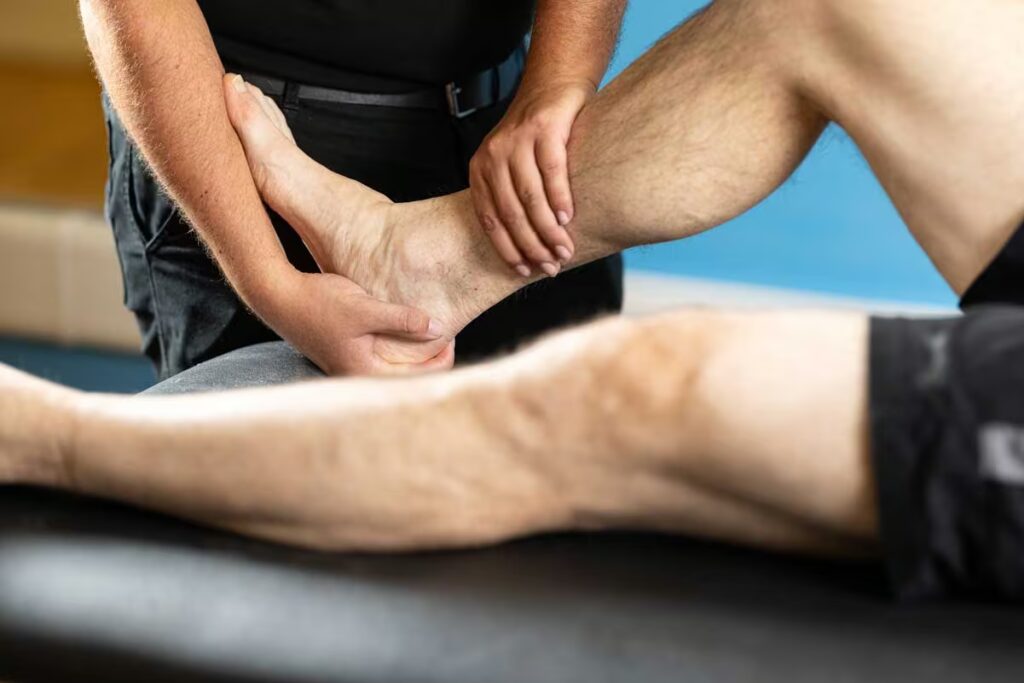
A rupture of the Achilles tendon is a partial or complete tear of the tendon. It occurs suddenly, sometimes with a popping sound, and is normally very debilitating. Some people describe rupturing the Achilles tendon as feeling like they have been shot in the back of the ankle.
A full rupture means the Achilles tendon is completely torn so that it no longer connects the calf muscle to the heel which means the calf muscle is completely unable to function. Achilles tendon ruptures are most likely to occur in sports requiring sudden stretching of the tendon, such as sprinting and squash. Occasionally, the Achilles tendon may rupture suddenly from a relatively routine movement like walking down a curb. Achilles tendon ruptures can happen to anyone, but are most likely to occur in people over the age of 40, males more so than females.
An Achilles tendon rupture will require urgent review by a specialist who can help you decide the best course of treatment. This may be surgical repair or conservative management, both of which require a period of immobilisation and then gradual reintroduction of weight bearing and ankle movement. Following this, you will require several months of rehabilitation to help restore your strength and balance and help you return to your normal activities.
We use cookies to personalise content and analyse traffic. You can choose which cookies to allow. Privacy Policy • Cookie Policy • Terms & Conditions • Google Privacy
We use cookies to help you navigate efficiently and perform certain functions. You can choose which categories to allow below. Cookies categorised as Necessary are always active.
We also use third-party cookies for analytics and advertising. These are only stored with your consent. You can update or withdraw consent at any time via the cookie icon at the bottom-left. This site operates under UK GDPR, the Data Protection Act 2018, and the Privacy and Electronic Communications Regulations (PECR). Cookie Policy • Privacy Policy
Necessary cookies are required for core site features including security, network management, and consent storage.
| Cookie | Duration | Description |
|---|---|---|
hmdg_cookie_consent | 180 days | Stores your cookie consent preferences. |
PHPSESSID | Session | WordPress session identifier. |
wordpress_logged_in_* | Session | WordPress login authentication. |
Functional cookies enable enhanced features such as live chat and remembering preferences.
| Cookie | Duration | Description |
|---|---|---|
wp-settings-* | 1 year | Stores user interface preferences. |
Analytics cookies help us understand visitor behaviour. Controls analytics_storage for Google Analytics 4.
| Cookie | Duration | Description |
|---|---|---|
_ga | 2 years | Google Analytics — distinguishes users. |
_ga_* | 2 years | Google Analytics 4 — session persistence. |
_gid | 24 hours | Google Analytics — distinguishes users. |
_gat | 1 minute | Google Analytics — throttles request rate. |
Performance cookies collect aggregate, anonymous data about site performance.
| Cookie | Duration | Description |
|---|---|---|
_gat_gtag_* | 1 minute | Google Tag Manager — rate throttle. |
Marketing cookies track visits to deliver relevant ads. Controls ad_storage, ad_user_data, and ad_personalization.
| Cookie | Duration | Description |
|---|---|---|
_gcl_au | 90 days | Google Ads — conversion tracking. |
_gcl_aw | 90 days | Google Ads — click attribution. |
_gac_* | 90 days | Google Ads — campaign information. |
IDE | 1 year | Google DoubleClick — ad targeting. |
Powered by HMDG • Cookie Policy