
Hypermobility, once referred to as “double jointedness,” is more than just being very flexible in your joints and muscles. Hypermobility can affect all types of connective tissue in the body including the internal organs, eyes and skin.
The stability in our joints is determined by the elasticity in the ligaments, the muscular control of the joint and the shape and structure of the joint. People who are hypermobile have more elasticity in their ligaments due to a result of a higher proportion of elastin to collagen in their ligaments. As a result, their joints are able to move more.
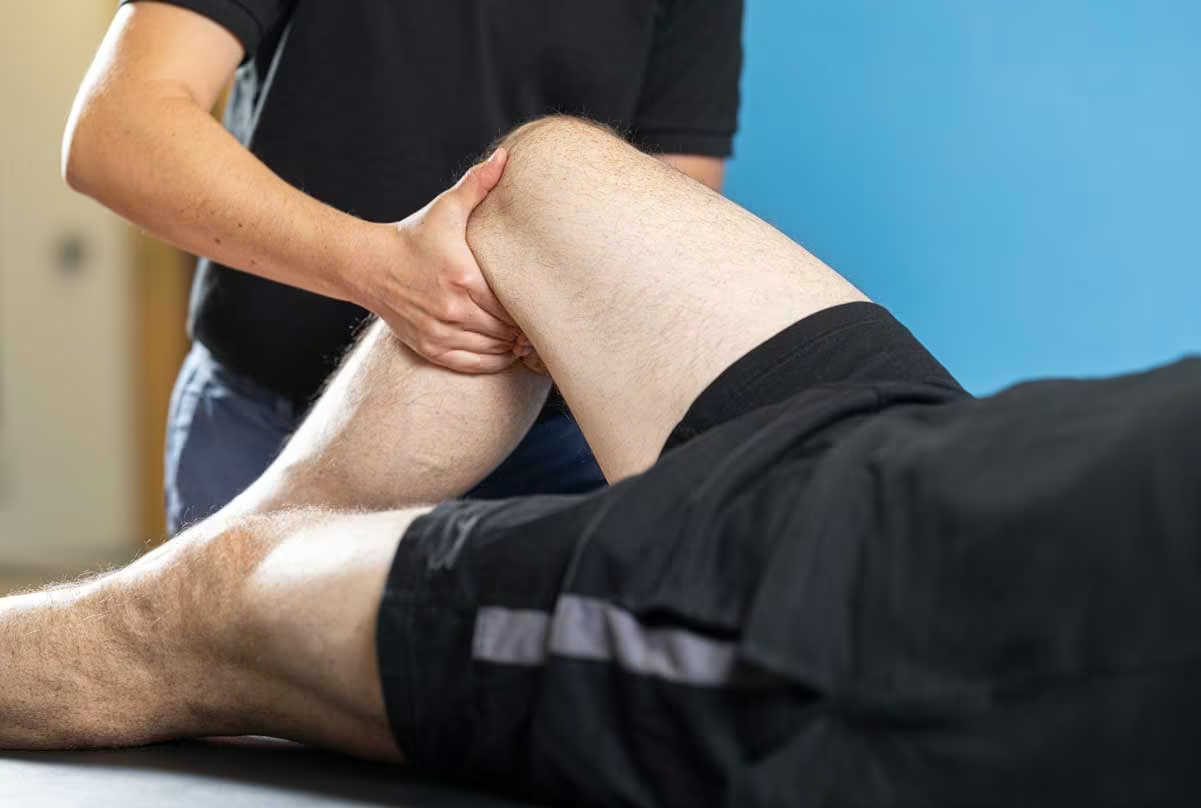
Being hypermobile is not necessarily a problem in itself, and is not necessarily a diagnosis either. With regards the skeletal system, the problem can be thought of as the muscles needing to work more to control the joint in its normal movement; the more movement, the more control is needed. People who are hypermobile are often more vulnerable to joint dysfunction and subsequently, pain.
Hypermobility has always existed, but has only more recently become more recognised. Hypermobility problems can sometimes occur as part of a greater syndrome which can sometimes have potentially quite serious consequences. Some hypermobility related syndromes include Marfan Syndrome, Ehlers-Danlos Syndrome and Benign Joint Hypermobility Syndrome.

We use cookies to personalise content and analyse traffic. You can choose which cookies to allow. Privacy Policy • Cookie Policy • Terms & Conditions • Google Privacy
We use cookies to help you navigate efficiently and perform certain functions. You can choose which categories to allow below. Cookies categorised as Necessary are always active.
We also use third-party cookies for analytics and advertising. These are only stored with your consent. You can update or withdraw consent at any time via the cookie icon at the bottom-left. This site operates under UK GDPR, the Data Protection Act 2018, and the Privacy and Electronic Communications Regulations (PECR). Cookie Policy • Privacy Policy
Necessary cookies are required for core site features including security, network management, and consent storage.
| Cookie | Duration | Description |
|---|---|---|
hmdg_cookie_consent | 180 days | Stores your cookie consent preferences. |
PHPSESSID | Session | WordPress session identifier. |
wordpress_logged_in_* | Session | WordPress login authentication. |
Functional cookies enable enhanced features such as live chat and remembering preferences.
| Cookie | Duration | Description |
|---|---|---|
wp-settings-* | 1 year | Stores user interface preferences. |
Analytics cookies help us understand visitor behaviour. Controls analytics_storage for Google Analytics 4.
| Cookie | Duration | Description |
|---|---|---|
_ga | 2 years | Google Analytics — distinguishes users. |
_ga_* | 2 years | Google Analytics 4 — session persistence. |
_gid | 24 hours | Google Analytics — distinguishes users. |
_gat | 1 minute | Google Analytics — throttles request rate. |
Performance cookies collect aggregate, anonymous data about site performance.
| Cookie | Duration | Description |
|---|---|---|
_gat_gtag_* | 1 minute | Google Tag Manager — rate throttle. |
Marketing cookies track visits to deliver relevant ads. Controls ad_storage, ad_user_data, and ad_personalization.
| Cookie | Duration | Description |
|---|---|---|
_gcl_au | 90 days | Google Ads — conversion tracking. |
_gcl_aw | 90 days | Google Ads — click attribution. |
_gac_* | 90 days | Google Ads — campaign information. |
IDE | 1 year | Google DoubleClick — ad targeting. |
Powered by HMDG • Cookie Policy