
Shin splints is a term for pain in the shin bone (tibia) that occurs due to repetitive impact, such as running and jumping. The medical terms used are periosteitis or Medial Tibial Stress Syndrome (MTSS).
As our foot impacts with the ground, the leg needs to absorb the force of impact. This force is absorbed by the foot first then dissipated up the whole leg, pelvis and spine. Muscles have a very important role in the force absorption as well.
When the force is not being dissipated normally, the impact becomes more focussed in the lower leg area, and the muscles of the lower leg need to do much more work. These muscles therefore apply greater tension on their attachments to the bone, which can cause the tissue surrounding the bone to break down and become inflamed. Pain is felt as the muscle continues to pull on this inflamed tissue, and continued overload can cause the bone itself to start to breakdown.

The amount of damage caused by overloading the bone due to high impact can be thought of as a continuum. In all cases, we have an on-going process of the microscopic bone structure breaking down day, however the body is normally able to repair and regrow new bone to replace this at an equal rate.
When the impact becomes excessive or too frequent, the bone starts to break down at a rate faster than the body can repair itself. At first this will present as shin splints, but as the rate of bone breaking down increases, it can become a stress response and then a stress fracture.

A stress fracture is a fracture of the bone’s structure that is an accumulation of microfractures in the bony cortex which the body is not able to repair fast enough. Eventually, if the repetitive load continues, the bone can break down completely and become a full fracture. Because of the high risk of stress responses and stress fractures turning into full fractures and potentially causing permanent damage, they must always be treated as very serious injuries.
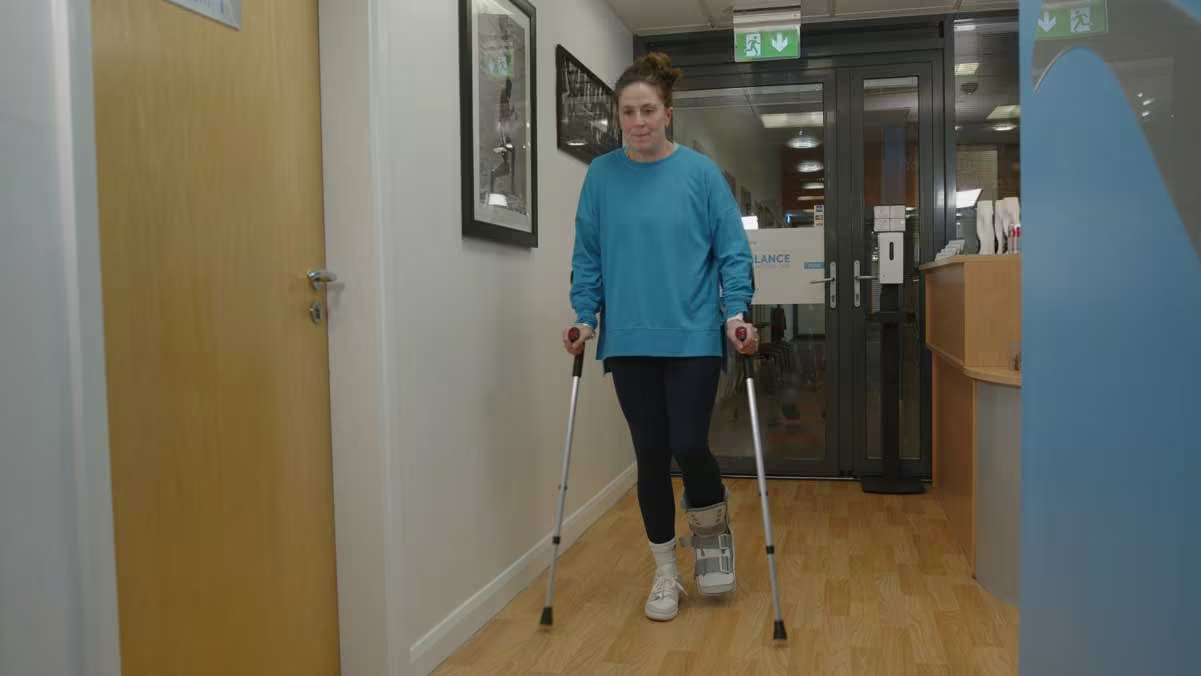
A period of rest and immobilisation for 4-12 weeks is very normal and is essential to allow the bone to heal. Physiotherapy aims to reduce the muscle tightness and address the biomechanical factors which contributed to the injury in the first place. Once the stress fracture is showing signs of suitable healing, a physiotherapist will guide you through a return to running and jumping, ensuring that you adapt better strategies for shock absorption and impact endurance.
We use cookies to personalise content and analyse traffic. You can choose which cookies to allow. Privacy Policy • Cookie Policy • Terms & Conditions • Google Privacy
We use cookies to help you navigate efficiently and perform certain functions. You can choose which categories to allow below. Cookies categorised as Necessary are always active.
We also use third-party cookies for analytics and advertising. These are only stored with your consent. You can update or withdraw consent at any time via the cookie icon at the bottom-left. This site operates under UK GDPR, the Data Protection Act 2018, and the Privacy and Electronic Communications Regulations (PECR). Cookie Policy • Privacy Policy
Necessary cookies are required for core site features including security, network management, and consent storage.
| Cookie | Duration | Description |
|---|---|---|
hmdg_cookie_consent | 180 days | Stores your cookie consent preferences. |
PHPSESSID | Session | WordPress session identifier. |
wordpress_logged_in_* | Session | WordPress login authentication. |
Functional cookies enable enhanced features such as live chat and remembering preferences.
| Cookie | Duration | Description |
|---|---|---|
wp-settings-* | 1 year | Stores user interface preferences. |
Analytics cookies help us understand visitor behaviour. Controls analytics_storage for Google Analytics 4.
| Cookie | Duration | Description |
|---|---|---|
_ga | 2 years | Google Analytics — distinguishes users. |
_ga_* | 2 years | Google Analytics 4 — session persistence. |
_gid | 24 hours | Google Analytics — distinguishes users. |
_gat | 1 minute | Google Analytics — throttles request rate. |
Performance cookies collect aggregate, anonymous data about site performance.
| Cookie | Duration | Description |
|---|---|---|
_gat_gtag_* | 1 minute | Google Tag Manager — rate throttle. |
Marketing cookies track visits to deliver relevant ads. Controls ad_storage, ad_user_data, and ad_personalization.
| Cookie | Duration | Description |
|---|---|---|
_gcl_au | 90 days | Google Ads — conversion tracking. |
_gcl_aw | 90 days | Google Ads — click attribution. |
_gac_* | 90 days | Google Ads — campaign information. |
IDE | 1 year | Google DoubleClick — ad targeting. |
Powered by HMDG • Cookie Policy